Basilica Cistern
Back to all places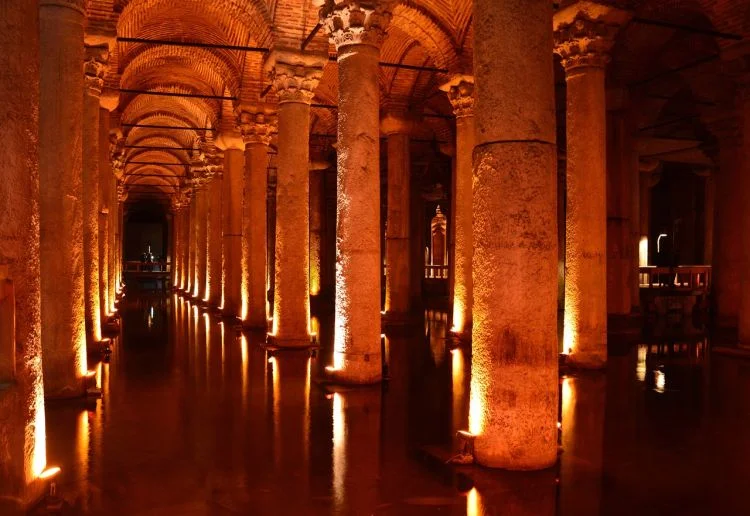
Beneath Istanbul lie hundreds of Byzantine cisterns, remnants from the time when the city was known as Constantinople. Many large Byzantine buildings were constructed with cisterns beneath them for water storage.
The grandest of these is the Basilica Cistern (Yerebatan Sarnıcı), named after the Stoa Basilica, a large commercial building that once stood above it. It is also referred to as the Sunken Palace Cistern (Yerebatan Saray Sarnıcı).
The Basilica Cistern was built in the 6th century during the reign of the Eastern Roman Emperor Justinian I. It was rediscovered in the 16th century by the French scholar Petrus Gyllius, who found its entrance after observing locals drawing water by lowering buckets through holes in their floors.
Although Istanbul is surrounded by the sea on three sides, fresh drinking water was scarce, prompting the construction of numerous cisterns throughout the city. The Basilica Cistern stored and supplied water for the city’s needs for centuries, including supplying the Topkapi Palace during the Ottoman period.
The cistern measures approximately 138 meters (453 ft) long and 64.6 meters (212 ft) wide, covering about 9,800 square meters (2.4 acres). It can hold around 80,000 cubic meters (over 21 million US gallons) of water and contains 336 marble columns.
The Basilica Cistern was featured in the James Bond film `From Russia With Love,` where Bond rows a small boat among the columns.
The columns are carved in various styles; one is known as the `weeping column,` though its significance is uncertain. A notable feature is the presence of two Medusa heads used as column bases, positioned sideways and upside down. Their exact origin and symbolism are unclear, but legends attribute protective qualities to these heads.
Medusa, in Greek mythology, was a Gorgon whose gaze could turn people to stone. According to myth, she was cursed by Athena and ultimately defeated by the hero Perseus.
The Basilica Cistern is open to visitors every day from 9 am to 7 pm.
Photo: narya
41.00838, 28.97788