Golden Horn
Back to all places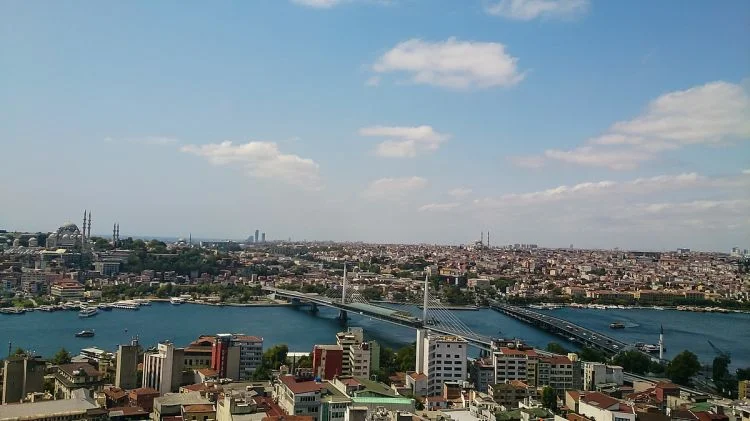
As the sun sets in Istanbul, its yellow light blazes across the waters of the Golden Horn, giving this brackish water estuary its romantic name...
"Golden Horn" is its western name. Its Turkish name, Haliç (hah-LEECH, from Arabic), has nothing to do with gold or horns. Haliç, short for Haliç-i Dersaadet, means "Gulf of Istanbul".
It is a body of water that separates the north and south, the "old" and the "new" parts of European Istanbul. You can take a ferry on it.
The Galata Bridge crosses the Golden Horn at its mouth, connecting Eminönü and Sirkeci in Old Istanbul (Sultanahmet in the middle) in the south with Karaköy (Galata) and Beyoğlu (Pera) in the north.
This short river/estuary may have gotten its romantic "golden" name because it was the commercial heart of the city, a major port for Byzantium, Constantinople, and Istanbul for 2,000 years until the mid-20th century. There are still many markets here and the Istanbul Chamber of Commerce has its offices here.
During the Byzantine period, there were colonies of the Italian city-states on the banks, and the southern end of the Galata Bridge in Eminönü was the Karaite Jewish quarter. In later times, Sultan Süleyman the Magnificent and Rüstem Pasha built the magnificent Rüstem Pasha Mosque here.
During the Ottoman period, Sephardic Jews fleeing the persecution of the Spanish Inquisition were accepted into the empire and settled in Balat and Hasköy on the Golden Horn.
During the late Ottoman period, the Orient Express from Paris traveled around Seraglio Point and stopped at Sirkeci Station under the walls of Topkapı Palace at the mouth of the Golden Horn.
European trains to Istanbul no longer arrive at Sirkeci station, but international cruise ships and ferries still arrive at Yolcu Salonu in Karaköy (Galata), north of the Golden Horn estuary.
https://turkeytravelplanner.com/go/Istanbul/Sights/GoldenHorn/index.html
Photo: Rraj89
41.02917, 28.96111